

Terrestrial FAQ
Radio Regulations
Radio Regulations
What are the Radio Regulations
The Radio Regulations (RR) are one of the instruments of the ITU, which contains a set of international rules on the use of spectrum and orbit for radiocommunications. The RR are ratified by governments and mandatory for application by all administrations.
How do the Radio Regulations work?
The Radio Regulations are the principal instrument of the international radio-regulatory arrangement, annexed to the ITU Convention. They define the rules to be applied in using the spectrum, as well as the rights and obligations resulting from this use. The international Radio Regulations are based on the use of two main concepts:
- Allocations of frequency blocks to defined radio services through the Table of Frequency Allocations, as contained in Article 5 of the RR. This concept generally provides common frequency allocations to mutually compatible services operating with similar technical characteristics in specific parts of the spectrum. It also provides stable planning environment for administrations, for equipment manufacturers and for users.
- The concept of voluntary or obligatory regulatory procedures (for coordination, notification and recording in the Master Register, resolving cases of harmful interference) those are adapted to the allocation structure.
Are we obliged to apply the Regulations?
Ratification of the ITU Convention by the governments of the ITU Member-States implies acceptance of the Radio Regulations.
Who can amend the Radio Regulations?
Only a World Radiocommunication Conference (WRC) can amend the Radio Regulations.
What is the Rules of Procedure?
The Rules of procedure (RoPs) is a regulatory document which incorporates the results of meetings of the Radio Regulations Board (12 elected officials meeting 3 times per year). The RoPs complement the Radio Regulations providing clarification of particular provisions, which are difficult for practical application or may be interpreted differently. There are 3 main types of RoPs: rules on Radio Regulations and Regional Agreements, rules standardizing practices of the BR and rules defining RRB working methods. Draft RoPs are prepared by the BR, circulated through ITU administrations for comments and approved by the RRB. Some RoPs are transferred to the Radio Regulations at world radiocommunication conferences. RoP can be purchased or downloaded through the ITU web page
(https://www.itu.int/pub/R-REG-ROP/en).
Where can I find the latest version of the ITU Radio Regulations?
The latest version of the ITU Radio Regulations are available here

World agreements
World agreements
What is the difference between “assignment Plan” and “allotment Plan”?
In Assignment Plan a frequency is authorized for use by specified stations. Stations using the same frequency are separated by distances large enough to provide interference-free operation. Distributing frequency to stations is called “assignment” resulting in term “assignment Plan”.
In Allotment Plan a frequency is authorized for use in specified geographical areas or countries. These areas are separated by the distances allowing re-use of the same frequency. Later, administrations responsible for such areas assign frequencies to any station located in these areas. Distributing frequency to areas is called “allotment” resulting in term “allotment Plan”.
“Which worldwide plans have been established under the auspices of the ITU for terrestrial services?
The following worldwide plans have been established, under the auspices of the ITU, for the terrestrial services, and they form part of the Radio Regulations:
• The frequency allotment plan for coast radiotelephone stations operating in the exclusive maritime mobile bands between 4000 and 27500 kHz (Appendix 25 to RR);
• The frequency allotment plan for the aeronautical mobile (OR) service operating in the exclusive bands between 3025 and 18030 kHz (Appendix 26 to RR);
• The frequency allotment plan for the aeronautical mobile (R) service operating in the exclusive bands between 2850 and 22000 kHz (Appendix 27 to RR).
What frequency bands and services are regulated by the Appendix 25 Plan?
Appendix 25 contains worldwide allotment plan for maritime mobile service (coast radiotelephone stations) in its exclusive bands between 4 and 27.5 MHz.
How can my administration obtain a new frequency allotment in the Appendix 25 Plan ?
You have to submit via WISFAT a T15 notice with the information listed in FXM-Guide at http://www.itu.int/en/ITU-R/terrestrial/tpr/Documents/fxm-guide.pdf. The Bureau will publish this information in a special section of BRIFIC together with the list of administrations to coordinate with. Then you will have to obtain agreements of these administrations by following the procedure of Section I of Appendix 25.
What frequency bands and services are regulated by the Appendix 26 Plan?
Appendix 26 contains worldwide allotment plan for the aeronautical mobile (OR) service in its exclusive bands between 3 025 kHz and 18 030 kHz.
How can my administration obtain a new frequency allotment in the Appendix 26 Plan ?
You have to send a request by email or fax indicating the preferred band(s) to the BR official address BRMAIL@itu.int . If your administration has no allotment in the AP26 Plan he Bureau will select an appropriate allotment and enter it into the Plan. If your administration requests an additional allotment, the corresponding allotment will be entered in Appendix 26 only if it is compatible with the remaining allotments.
What frequency bands and services are regulated by the Appendix 27 Plan?
Appendix 27 contains worldwide allotment plan for the aeronautical mobile (R) service in its exclusive bands between 2 850 kHz and 22 000 kHz.
How can my administration obtain a new frequency allotment in the Appendix 27 Plan ?
The AP27 allotment Plan cannot be modified. However, an administration can notify and bring into service assignments that are not contained in the Plan subject to prior agreement from affected administrations. You may submit via WISFAT the proposed frequency assignment(s) using T12 notice type. The Bureau will check its compatibility with the Appendix 27 Plan, identify affected administrations and provide necessary recommendations.
Regional agreements
Regional agreements
What is the difference between “assignment Plan” and “allotment Plan”?
In Assignment Plan a frequency is authorized for use by specified stations. Stations using the same frequency are separated by distances large enough to provide interference-free operation. Distributing frequency to stations is called “assignment” resulting in term “assignment Plan”.
In Allotment Plan a frequency is authorized for use in specified geographical areas or countries. These areas are separated by the distances allowing re-use of the same frequency. Later, administrations responsible for such areas assign frequencies to any station located in these areas. Distributing frequency to areas is called “allotment” resulting in term “allotment Plan”.
Which regional plans were established under the auspices of the ITU for the terrestrial services other than broadcasting?
Frequency assignment plan for stations of the maritime mobile and aeronautical radionavigation service in the MF bands in Region 1 annexed to the Regional Agreement concerning the MF maritime mobile and aeronautical radionavigation services in Region 1, Geneva, 1985 (GE85- MM-R1);
Frequency assignment plan for stations of the maritime radionavigation service (radiobeacons) for the European Maritime Area in the band 283.5 – 315 kHz annexed to the Regional Agreement concerning the planning of the maritime radionavigation service (radiobeacons) in the European Maritime Area, Geneva, 1985 (GE85-EMA);
The details of relevant Plan are shown in the ITU web page
(http://www.itu.int/en/ITU-R/terrestrial/fmd/Pages/frequency-plans.aspx ).
GE06 Transition period
GE06 Transition period
What is the transition period for GE06 Agreement?
17 June 2015 is the date corresponding to the end of the “transition period”, as specified by the GE06 Agreement.
The 119 Administrations part of this Agreement have agreed to this deadline and are expected to respect it, which does not mean that they have to cease analogue transmissions.
From 2004 to 2006, Africa, Arab countries, Europe and Iran, have been planning frequencies for the digital broadcasting and set a deadline of the transition from analogue to digital broadcasting, respectively 17 June 2015 for 119 countries in Europe, Africa, Middle East and Central Asia, with a waiver until 17 June 2020 for VHF only in 34 countries, These deadlines, which were set at the Regional Radiocommunication Conference, Geneva 2006 (RRC-06), were taken by consensus and accepted by all Member States participating in this conference.
§ 1.16 and 12.6 of the GE06 Agreement define the transition period as the period following the Conference during which the assignments in the analogue Plan shall be protected.
It started after the RRC-06 (17 June 2006) and shall end on 17 June 2015 at 0001 hours UTC. However, for the countries listed in footnote below *1), for the band 174-230 MHz *2), the Transition period shall end on 17 June 2020 at 0001 hours UTC.
*1) List of the countries: Algeria (People’s Democratic Republic of), Burkina Faso, Cameroon (Republic of), Congo (Republic of the), Côte d’Ivoire (Republic of), Egypt (Arab Republic of), Gabonese Republic, Ghana, Guinea (Republic of), Iran (Islamic Republic of), Jordan (Hashemite Kingdom of), Mali (Republic of), Morocco (Kingdom of), Mauritania (Islamic Republic of), Nigeria (Federal Republic of), Syrian Arab Republic, Sudan (Republic of the), Chad (Republic of), Togolese Republic, Tunisia, Yemen (Republic of).
For the following administrations which were not present at RRC 06, namely Benin (Republic of), Central African Republic, Eritrea, Ethiopia (Federal Democratic Republic of), Guinea-Bissau (Republic of), Equatorial Guinea (Republic of), Liberia (Republic of), Madagascar (Republic of), Niger (Republic of the), Democratic Republic of the Congo, Sao Tome and Principe (Democratic Republic of), Sierra Leone and Somali Democratic Republic, the date of the end of the transition period in the VHF band (174-230 MHz) is 17 June 2020 at 0001 hours UTC, unless any of the aforementioned administrations communicates to the Bureau during the 90 day period from the end of RRC 06 that it selects 17 June 2015 at 0001 hours UTC.
*2) 170-230 Mhz for Morroco
Why is there a transition period for GE06 Agreement?
In developing the frequency plan included in the GE06 Agreement for digital television broadcasting transmissions (the “GE06 Plan”), two options were considered:
• Design the digital plan to ensure mutual compatibility between analogue and digital transmissions, i.e. coexistence without harmful interference. This would have allowed full flexibility as to the date at which the digital switchover would occur in each country, but would have led to a very inefficient plan once analogue transmissions have ceased since a large part of the spectrum would remain unused.
• Design the digital plan independently of the analogue plan, which had existed in Europe since 1961 and in Africa since 1989. This implied to define a transition period until the end of which analogue transmissions would have priority (digital transmissions were required to protect analogue transmissions and not claim protection from them) and after which the opposite would happen, i.e. digital transmission would have priority (analogue transmissions are required to protect digital transmissions which are in conformity with the plan and cannot claim protection from them). This second option was the one retained in the GE06 Agreement.
On 17 June 2015, we have reached the end of the transition period, therefore digital transmissions which are in conformity with the GE06 Plan now have priority over analogue transmissions, among the 119 countries of the GE06 Agreement.
From 17 June 2015, the full potential of digital TV broadcasting in these 119 countries will therefore become available.
Are analogue TV transmissions prohibited after 17 June 2015?
No.
The end of the transition period does not mean the end of analogue TV transmissions. It means that their regulatory status is reduced but they may continue to be in operation, provided that they protect digital transmissions operating in conformity with the GE06 plan. In addition, they cannot claim protection from these digital transmissions.
What happens after the 17 June 2015?
After the end of the above-mentioned Transition period, the Bureau shall cancel entries in the analogue Plan, review the status of the assignments recorded in the Master International Frequency Register (MIFR) and invite the administrations to cancel the corresponding entries in the MIFR. (Article 12 of the GE06 Agreement). The Analogue Plan will cease to exist.
This does not mean that analogue transmissions are prohibited. It just means that their protection is no longer ensured at the international level, and that they must protect digital transmissions which are in conformity with the GE06 Plan.
Concretely, it means that in the border areas of a country, new interference constraints may arise for previously authorized analogue transmissions: their power may be required to protect digital transmissions of the neighbouring countries and they may have to accept interference from these digital transmissions.
Has an extension of the deadline been discussed? Why?
The answer is “No”.
As the specialized agency of the United Nations dealing with information and communication technologies, including Spectrum and satellite orbit issues, ITU applies the decisions taken by administrations at World Radiocommunication Conferences and Regional Conferences, such as those related to setting deadlines.
In this case, the deadline was agreed by a consensual decision of all participating Member States in an ITU Regional Radiocommunication Conference and modifying this decision would require to convene another regional radiocommunication conference, which is certainly not envisaged and not necessary.
How to notify analogue assignments to the MIFR?
The administrations willing to record in the MIFR, new analogue broadcasting assignments have 2 options:
According to §5.1.3 of the GE06 Agreement, an Administration may use a recorded digital assignment to operate an analogue station, under the condition that the analogue assignment does not cause more interference, nor require more protection than the Digital one. The analogue assignment under the envelope of the digital Plan entry will have the rights of protection and recognition.
Notify directly the analogue assignment to the MIFR (see § 5.1.7 of the GE06 Agreement) with the condition not to cause unacceptable interference to, and not claim protection from, any assignments in conformity with the Agreement and its associated Plans. The analogue assignment will be recorded in the MIFR only for information.
Why is it important to migrate to digital broadcasting?
As for all other technologies, TV and radio broadcasting also followed the trend to go digital owing to the numerous advantages offered by digital technology. Among the advantages of digital broadcasting:
New possibilities to the viewers:
• Additional number of programmes
• Additional reception modes: portable and mobile reception
• Improved quality of image and sound, including HDTV
• Additional services: interactivity, Electronic Programme Guides, etc.
TV operators/content providers: Significant decrease in transmission costs compared to analogue:
• Power costs: DTT requires less energy to ensure the same coverage as for analogue,
• Investment cost: One DTT transmitter can broadcast multiple channels/programmes, leading to reduction of transmission costs (Sharing infrastructure)
• Development of new TV services without spectrum constraints
• Offering new innovative services (mobile TV, data, games, interactivity, VoD)
For Regulators:
• More efficient use of radio spectrum
• Increased competition: To develop a terrestrial platform competitive with cable and satellite platforms
• To be in line with GE06 Plan (as from 2015 no protection will be available to analogue TV)
• Release a part of the UHF Band for mobile Broadband (as made possible by World Radiocommunication Conferences in 2007 and 2012 – WRC-07/WRC-12), knowing that
o A dynamic wireless broadband industry can contribute towards economic growth and job creation.
o The 700 and 800 MHz bands enable the provision of broadband mobile services at a much reduced price due to the excellent propagation characteristics of these frequencies.
o Global harmonization of the use of the 700 and 800 MHz bands by the mobile service is progressing well, by the adoption, in Latin America, Asia and Europe, of frequency arrangements which can be used concurrently for both bands in the same terminals. The use of these arrangements in African countries will benefit from the economies of scale of the worldwide market for user terminals and network equipment, contributing to the reduction of the digital divide.
What is the relation between digital transition and the digital dividend?
At the end of the transition from analogue to digital television, analogue transmissions will be switched off. This will release valuable spectrum, known as the digital dividend, which will then become available either for broadcasting (e.g. to provide more TV channels or higher quality TV channels such as HDTV), or for broadband mobile, in order to reduce the digital divide by providing broadband internet access to geographical areas which are still not covered by 3G or 4G.
Processing of notifications of frequency assignments to analogue television broadcasting stations for recording in the Master Register (MIFR) after the transition period (17 June 2015)
References: Regional Agreement GE06, Radio Regulations, Article 11
The procedure described below applies in the bands and planning area of GE06 as follows:
– In the UHF band to all administrations party to the GE06 Agreement
– In the VHF band to those administrations party to the GE06 Agreement that are not mentioned in footnote 7 of Article 12 of the Agreement
Analogue Plan
According to provision 12.6 of the GE06 Agreement, at the end of the transition period, all entries of the analogue Plan were deleted and the provisions of § 4.1 of Article 4 referring to the modification of the analogue Plan are no longer applicable;
MIFR
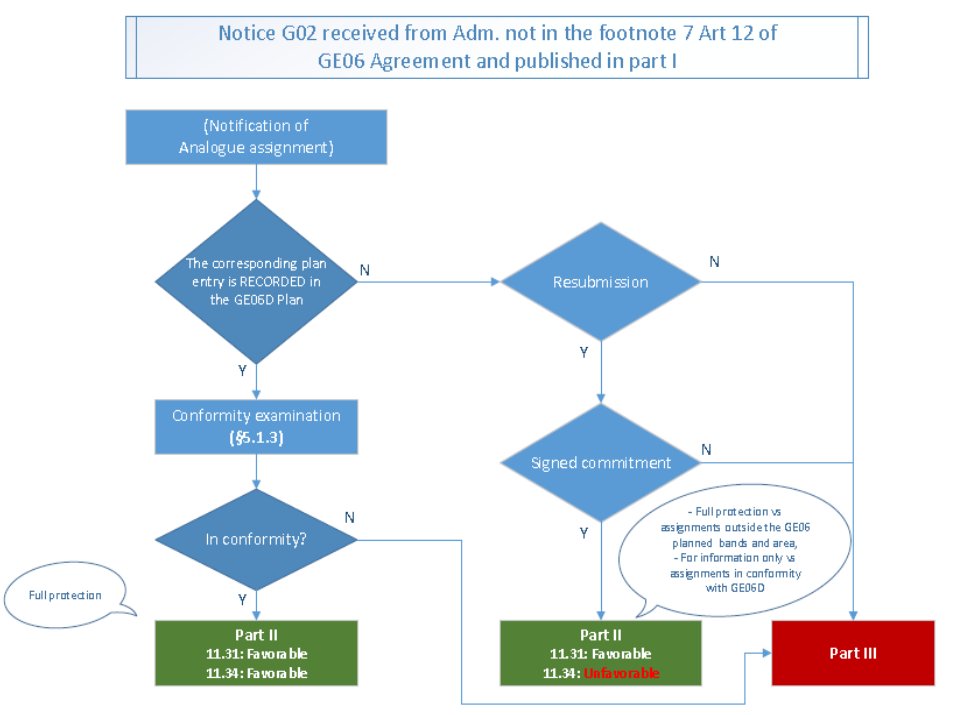
According to No. 11.34 point 2.2.3 of part A1 of the Rules of Procedure (RoP), the administrations willing to notify analogue broadcasting assignments (in the bands and planning area of the GE06 Agreement) have to follow the procedure of Article 5 of the GE06 Agreement.
Two possibilities are foreseen:
• The analogue assignment notified uses the spectrum mask of a Digital Plan entry (notice type G02) (provision 5.1.3. of the GE06 Agreement):
– If the assignment is in conformity with the digital plan entry (according to Part A10 of RoP and section II of the Appendix4 of the GE06 Agreement), it will be recorded in the MIFR with favourable findings.
– If it is not in conformity, the notification will be returned to the administration.
• The analogue assignment notified without making reference to any Digital Plan entry (notice type G02) (provision 5.1.2 of the GE06 Agreement):
If there is no corresponding Digital plan entry, the assignment will be returned to the notifying administration with the specification of “no target found”, and the assignment will be published in Part III of the BR IFIC.
The notifying administration can resubmit under provision 5.1.7 of the GE06 Agreement, with a signed commitment that the assignment shall not cause unacceptable interference to, nor claim protection from, any station operating in conformity with the Agreement and its associated Plans (GE06D and the List).
The assignment will then be recorded in the MIFR with Favourable finding with respect to RR11.31, and Unfavourable finding with respect to RR11.34.
The following chart shows the notification process described above.
Broadcasting services
Broadcasting services
Online Tools
Is it possible to add functionality for calculation of LF/MF broadcasting coordination?
GE75 (LF/MF) Article 4 calculations are not available online at present. However, users are invited to send the notice forms for proposed modifications to brbcd@itu.int with LF/MF calculations in the subject. Calculations will be carried out on the BR stand-alone system and results will be sent back you as soon as possible.
How can I know when my notices are ready for publication in Part B and is there an automated tool for generating the notices to request publication in Part B?
You can see those notices in the BR IFIC and TerRaNotices allows for generating those notices. In addition, myAdmin tool allows to display the notices ready for Part B (all agreement obtained and regulatory deadline has passed). The notices can be exported as SGML and submitted via WISFAT.
How can I verify if coordination information relevant for my notices has reached the BR?
With eBCD2.0 online tools (eQry and myAdmin) you can visualize the quasi-live (1 day delay) coordination information for relevant notices. In addition you can subscribe to e-mail notification services (myProfile feature of myAdmin).
How can I access eBCD tools?
You need to login with your TIES account.If you do not have one: 1. Submit your request through the online application form. (http://www.itu.int/online/mm/scripts/reg.screen1.html?_languageid=1) 2. The Focal Point of your organization/company will receive an email for authorization 3. Once the Focal Point has authorized the request, the new TIES account is created.
How can I visualize the coordination contours for my notices published in a GE06D Special Section?
From ePub you can click on the link showing the number of assignment published in Part A1 or the relevant Special Section. All the record published in Part A1 will be shown. Select your administration on the list of Notifying Administration, to facilitate your search. Click on the link of the Unique identification code of the relevant assignment or allotment and you will see the details on your notice. Clicking on the tab “Coordination Exam Result” will display the coordination contour. You can also visualize those contours from eQry and myAdmin.
Regional Plans
My administration would like to implement other broadcasting applications within the rights reserved of a Plan entry. How can this be notified to the BR?
By submission of appropriate notice forms such as GB1 (for digital broadcasting applications) or G02 (for analogue television).
For the notification of T-DMB assignments, is it possible to use GS1 notice form or do we need to use GB1?
It is necessary to use GB1 notice form.
What notice form should be used for the notification of a T-DAB assignment as the implementation of a DVB-T Plan entry?
The notice form is GS1.
What is required for notification in terms of Article 5 for “Plan remark conditions met”?
The notice shall contain the field t_remark_conds_met = TRUE as well as the names of the respective administrations in the COORD section.
The notice for resubmission under provisions 5.1.8 and 5.2.6 of the GE06 agreement shall include a signed commitment. Is there a form (sample) to write this commitment?
There is no specific form for the commitment. A duly signed covering letter
from the notifying administration should contain reference to 5.1.8 for the respective
resubmissions. The notices must contain the fields t_signed_commitment =TRUE and t_is_resub = TRUE as indicated in the Guidelines for GE06 submissions:
http://www.itu.int/ITU-R/terrestrial/docs/notice-forms/ge06/BS-GE06_Guide.pdf. The same applies to Provision 5.2.6 for other primary services.
How the aggregate interference is being calculated under Article 5 treatment?
The aggregate interference is calculated using the power sum of the
interference contributions from:
– assignments already recorded in the MIFR as a result of the conversion of the
allotment element; and
– linked assignments corresponding to the digital Plan entry, which have already been
recorded in the MIFR; and
– the new assignments resulting from the conversion of the allotment element of the
digital Plan entry and submitted under Article 5 for recording in the MIFR; and
– linked assignments corresponding to the digital Plan entry and submitted under Article 5 for recording in the MIFR.
Is there any procedure to be applied in order to remove the restrictions in the Plan GE06 (deleting the Plan Remarks in the columns R-1,2 or 3), since the necessary agreements have been received?
The Regional Agreement GE06 did not establish a procedure regarding the deletion of the “Remarks” column in the digital broadcasting plans annexed to the GE06 Agreement. Your Administration is invited to submit the necessary coordination information, as envisaged in provision No. 5.1.2b (second indent) of the GE06 Agreement, at the time of the notification of the concerned frequency assignment, under Article 5 of the GE06 Agreement. After the end of transition period, remarks related to analogue assignments will not be taken into account.
What is the geographical coordinate system used in GE06?
Since the RRC-06 did not enforce any particular geographical coordinate system, the geographical coordinates notified by administrations are considered to represent locations on a spherical earth model (radius = 6373 km) as used in the IDWM routines.
How is the centre of gravity of an allotment calculated?
There is no general formula for the centre of gravity and the surface of a polygon (or set of polygons) on a sphere. However, the centre of gravity of a spherical triangle is known to lie on the intersection of its medians, and there exists a formula to calculate its surface. These properties of spherical triangles are used to obtain the centre of gravity of an allotment as follows: a. The allotment contour (polygon) is subdivided into spherical triangles.
The centre of gravity and the surface area are calculated for each triangle.
The (lon, lat) coordinates of the centre of gravity of each spherical triangle are converted into Cartesian coordinates (x,y,z).
b. The centre of gravity of the allotment is the weighted mean of the centres of gravity of its constituent spherical triangles where the surface areas of the triangles are taken as their relative weights.
c. The resulting centre of gravity lies inside the sphere, and needs to be brought back to the surface of the sphere by normalization along the radial.
The final result is obtained by reverting back to (lon, lat) coordinates.
Note: If the allotment has several sub-areas, the centre of gravity of the whole is obtained from the weighted average of the centres of gravity and the surface areas of the sub-areas. (The surface area of a sub-area is the sum of the surfaces of its constituent spherical triangles.) In this case, the centre of gravity of each sub-area is NOT brought back to the surface of the sphere and is NOT converted to (lon, lat) coordinates. It is only the final centre of gravity of all the sub-areas that requires these additional steps.
Where is the centre of gravity of a set of assignments with a common SFN identifier and without an allotment?
The center of gravity is calculated as follows:
a. The (lon, lat) coordinates of the transmitters are converted into Cartesian coordinates (x, y, z).
b. The mean of each of the Cartesian coordinates is determined.
c. The resulting centre of gravity lies inside the sphere, and needs to be brought back to the surface of the sphere by normalization along the radial.
d. The final result is obtained by reverting back to (lon, lat) coordinates.
Planning software
What are the basic GE06Calc software functionalities?
GE06 Calc is a PC-based application designed to assist administrations in the calculations related to the GE06 Plan for sound and television broadcasting services. The application reads electronic notice files and performs unofficial conformity examinations with respect to the GE06 Plan, for notices needing to be examined for conformity under Articles 4 or 5 of the RRC-06 Agreement.
GE06 Calc also provides multiple tools to analyze the results of a compatibility analysis examination previously submitted on the web – see eTools on:
https://www.itu.int/ITU-R/eBCD/MemberPages/eCalculations.aspx )
GE06 Calc is a complement to the BR IFIC (Terrestrial) DVD and it is recommended that the latest BR IFIC be installed so that characteristics of frequency assignments and proposed modifications are available.
Where can I find the GE06Calc software?
GE06 Calc is available for download at
http://www.itu.int/en/ITU-R/terrestrial/broadcast/Pages/Services.aspx.
The user is informed automatically at application startup when a new version of the software is available.
GE06 Calc does not start. What should I do?
Make sure that you have linked it to the BRIFIC. Please follow the step-by-step procedure described at:
http://www.itu.int/en/ITU-R/terrestrial/broadcast/ASMG/Documents/info/INFO-7-E.pdf
For any specific issue, please contact GE06.software@itu.int
GE06 Calc does not start on a Windows 64 bit platforms. What shall I do?
Please install the 64 bit driver of SQLite available at
http://www.ch-werner.de/sqliteodbc/
and click on sqliteodbc_w64.exe .
Then you may close and restart TerRaQ and resume the link.
Which data is considered by the conformity analysis?
The conformity analysis in GE06Calc considers the GE06 Plan data contained in the BRIFIC connected to it. For this reason, it is important to install the latest BRIFIC in order to consider the latest information concerning the characteristics of the frequency assignments and proposed modifications.
Can you briefly explain the channel distribution statistics of the compatibility analysis provided in GE06Calc?
1. In GE06Calc, open the database containing the compatibility results calculated in eTools.
2. Select an Administration after choosing the ‘channel distribution statistics’ menu item.
3. The statistics are based on the requirements/proposed modifications ‘submitted’ to the compatibility analysis examination tool for the Administration under consideration.
4. The number of ‘no available channel’ is always zero in the statistics on general compatibility analysis. This information is only valid in the case of sub-regional planning exercises such as ATU or ASMG.
5. ‘No assignable channel or frequency block’ shows the number of requirements for which the channel or frequency block is available (not yet RECORDED in the GE06 Plan) but not assignable due to incompatibilities (e.g. they are causing or receiving an interference margin higher than the maximum margin captured by the user)
6. The column ‘Having an assignable channel or a frequency block’ considers the number of compatible requirements (interference margin caused or received to/from any other station is less than the maximum acceptable margin captured by the user).
Please note that, during the establishment of the Digital Plan at RRC-06, it was agreed that a requirement is compatible with another digital requirement if the margin is < 1.25 dB.
Is the service area limited only to the national territory of the responsible Administration?
The GE75 Agreement clearly indicates that the boundary of a service area of a broadcasting station may fall outside the national territory of the responsible Administration.
Reference:
• Provision 4.3.2.5 of the Agreement;
• Chapter 1 of Annex 2 annexed to the Agreement
Would it be possible to notify an LF/MF assignment on 150 kHz and 285 kHz for the LF band, respectively, on 525 kHz and 1605 kHz for the MF band?
Taking into account the minimum necessary bandwidth of 9 kHz for the LF / MF service, these four frequencies could not be used because part of the channel falls outside the allocated frequency bands 148.5 kHz-248.5 kHz, 526.5 kHz-1606.5 kHz.
What is the procedure for recording modifications to the GE84 Plan, Part B, once the 100 day period is over?
In order to record the frequency assignments in the GE84 Plan, an administration must submit the TB3 electronic notices (Request for publication in Part B) via BR WISFAT system at (TIES login required):
Before submitting TB3 notices via WISFAT, you are invited to check the coordination data through the WEB application myAdmin at the following link (TIES login required):
You may wish to create the necessary electronic file by using myAdmin or TerRaNotices software available on the BR IFIC DVD and indicating in the coordination section all the names of administrations with which you are successfully coordinated.
What are the technical grounds for the coordination of FM and aeronautical radionavigation services in the context of the GE84 agreement?
a) CHAPTER 3 of Annex 4 of the Final Acts of GE84 Agreement: aeronautical radionavigation services of another administration are considered being affected if the distance from the sound broadcasting station to the nearest point on the boundary of that administration is less than 500 km. b) CHAPTER 7 of Annex 2 of the Final Acts of GE84 Agreement describes compatibility between the broadcasting services in the band 87.5 – 108 MHz and the aeronautical radionavigation service in the band 108 – 117.975 MHz. c) RECOMMENDATION ITU-R SM.1009.1 in its Annex 2 at the link below gives clarifications on technical data for coordination study related to these 2 services: https://www.itu.int/dms_pubrec/itu-r/rec/sm/R-REC-SM.1009-1-199510-I!!PDF-E.pdf
When is the usable field strength “Eu” recalculated to reflect the impact of a GE84 Plan modification?
According to the procedure for modification to the Plan as defined in Section 4.3.7.1 of Article 4 of the GE84 Agreement, the value of the usable field strength Eu is recalculated (see calculation in Chapter 4 of Annex 2) after every publication in Part B and/or Part C of the Special Section of the BR IFIC. The reference usable field strength of an assignment to be protected, Euref, is the field strength which results from the Plan adopted by the Conference or, for an assignment entered into the Plan after the Conference, the field strength which results from the Plan at the time this assignment was first recorded in the Plan. If, due to deletions or modifications, the usable field strength becomes lower, then this lower value becomes the new reference usable field strength.
What have both Administrations concretely to do so that the notifying administration A can publish the BC station in Part B and record it into the Plan once an agreement is obtained from an objecting administration B?
Pursuant to sections 4.4 and 4.6 of the GE84 Agreement, if agreement has been obtained subsequently from the objecting administration B, administration A is invited to provide the Bureau with a copy of the relevant correspondence from administration B (administration B can also provide the Bureau with its comment directly). In any case, the Bureau must receive comment (agreement) of the administration B in order to remove the objection recorded. Then administration A must submit electronic notices TB3 via WISFAT for publication of its proposed BC stations in Part B.
What shall I do when starting GE84PLN for the 1st time?
a) Install first BR IFIC in order to get and record the .MDB database needed to run GE84PLN.
b) Download and open GE84PLN application: on Preference under Option tab, fill in your administrative data as requested.
How do I modify the technical characteristics of a notice (to remove interferences)?
In order to make changes in notice values (site coordinates and/or frequencies) to remove interference, you may use the BR application for planning VHF-FM broadcasting services under GE84 Agreement- GE84PLN 1.6- on the link below:
http://www.itu.int/ITU-R/terrestrial/broadcast/software/GE84PLN/index.html
Solutions, on instructional videos, of exercises presented during Terrestrial workshops of the World Radiocommunication Seminar WRS dealing with the subject are on the same link above. In the matter, the changes in notice values may also concern of the use of true values of effective antenna height and attenuation calculated with SRTM3 terrain data.
How do I generate “my own test notice” for interference analysis or finding evaluable channel?
In GE84PLN, select a recorded assignment or a notice under treatment: -Correct/adapt the characteristics -Save as a New Notice -Under Calculate tab, run analysis See instructional videos on the link below: https://www.itu.int/ITU-R/terrestrial/broadcast/software/GE84PLN/index.html
Which are the regional agreements for the broadcasting service established under ITU auspices?
Those are:
a) for the frequency bands below 30 MHz:
– Geneva 75;
– Rio de Janeiro 81;
– Rio de Janeiro 88.
For more details please see http://www.itu.int/en/ITU-R/terrestrial/broadcast/Pages/LFMF.aspx
b) for the VHF and UHF bands:
– Stochholm 61 Rev. 2006;
– Geneva 84;
– Geneva 89 Rev. 2006;
– Geneva 2006.
For more details please see http://www.itu.int/en/ITU-R/terrestrial/broadcast/Pages/FMTV.aspx
How the HF broadcasting requirements should be notified?
A specific text file containing the seasonal schedule must be used for the notification. Detailed description of the file format and the technical specifications required can be found in the document entitled “File Format for submission of HFBC requirements”, available at the ITU / HFBC web site.
What should be notified when requirements are to be added, modified or suppressed?
Administrations must submit their whole seasonal schedule. The Bureau cannot accept submissions containing only amended requirements.
What if no schedule is submitted to the Bureau for a specific season?
The Bureau takes the requirements from the previous corresponding season and incorporates them into the current seasonal schedule. This action could be undertaken only once, and then the previously submitted data is suppressed from the database.
What are the regional plans for broadcasting services?
- ST61 – the European Broadcasting Conference in the VHF (41-68 MHz and 162-174 MHz) and UHF bands (174-230 MHz and 470-862 MHz), revised by RRC-06
- GE75 – Regional Agreement concerning the Use by the Broadcasting Service of Frequencies in the Medium Frequency Bands (525-1605 kHz) in Regions 1 and 3 and in the Low Frequency Bands (150-285 kHz) in Region 1
- RJ81 – Regional Agreement concerning the use by the broadcasting service of frequencies in the medium frequency bands (535-1605 kHz) in Region 2.
- GE84 – Regional Agreement concerning the use by the broadcasting service of VHF-FM radio (87.5 – 108 MHz) for Region 1, Afghanistan and the Islamic Republic of Iran.
- RJ88 – Regional Administrative Radio Conference to Establish a Plan for the Broadcasting Service in the Band 1 605 – 1 705 kHz in Region 2.
- GE89 – Regional Agreement for the Planning of VHF and UHF Television Broadcasting in the African Broadcasting Area and Neighbouring Countries. Frequency Band I: 47-68 MHz (limited to 54-68 MHz in BOT, BDI, LSO, MWI NMB, AFS, SWZ, COG, ZMB and ZWE); Band III: 230-238 MHz and 246-254 MHz (for BOT, LSO, MWI, MOZ, NMB, AFS, SWZ, ZMB and ZWE subject to agreement obtained under RR9.21)
- GE06 – The Regional agreement relating to the planning of the digital broadcasting service concerns Region 1 (parts of Region 1 situated to the west of meridian 170⁰E and to north parallel 40⁰S, except the territory of Mongolia) and in the Islamic Republic of Iran. Frequency bands: Band III: 174‑230 MHz; Band IV: 470‑582 MHz; Band V: 582‑862 MHz
What is List B and its status?
RJ81 List B contains stations which during the signature of Final Acts of RJ81 (FA RJ81) were operating and did not comply with the compatibility conditions imposed by FA RJ81 (they caused and/or received affectations of unaccepted interferences, which was not the case of the remaining RJ81 List A stations). Since the original Plan number of List B stations must only be reduced.
Why the need to resolve List B?
Stipulations of Resolution 2 to Final Acts of RJ81 and better use of the given spectrum in the Region.
What happens if they are not resolved?
Maintenance of the Plan remains complex and any update of the Plan due to MF digitization (larger matrix of cross-interference margins) becomes even more complicated.
What benefits resolving List B?
Better electromagnetic compatibility in MF in Region 2 (less harmful interferences produced and received) and consequently easier introduction of new stations as well as modification of existing ones.
Why the problems have not been resolved?
Many reasons: a) the limited time available during RJ81 Conference to carry out the necessary planning studies;b) during the Conference, it was not proved possible to solve a large number of long standing incompatibilities between stations;c) the lack of an appropriate software analyzing the level of harmful interferences received and produced by the related List B stations;d) the lack of an interactive software (with graphic presentations) showing the technical possibilities of interference reduction.
HF Broadcasting planning procedure
How the HF broadcasting requirements should be notified?
A specific text file containing the seasonal schedule must be used for the notification. Detailed description of the file format and the technical specifications required can be found in the document entitled “File Format for submission of HFBC requirements”, available at the ITU / HFBC web site.
What should be notified when requirements are to be added, modified or suppressed?
Administrations must submit their whole seasonal schedule. The Bureau cannot accept submissions containing only amended requirements.
What if no schedule is submitted to the Bureau for a specific season?
Fixed and Mobile services
Fixed and Mobile services
What are mandatory technical restrictions imposed on fixed service applications by the RR?
There are 3 groups of limitations. Firstly, there is a prohibition to use F3E and G3E emission in the fixed service below 30 MHz (RR24.2). Secondly, there are few power limits in footnotes of Article 5 of the RR mainly in HF bands, for example RR5.137. Thirdly, there are mandatory limits of the radiated power and power to antenna for fixed service stations above 1 GHz sharing the bands with space services, which are listed in RR21.3 – 21.7 of Article 21 of the RR.
What are mandatory technical restrictions imposed on land mobile service applications by the RR?
There are very few such restrictions. They include mandatory limits of the radiated power and power to antenna for land mobile stations above 1 GHz sharing the bands with space services, which are listed in RR21.3 – 21.7, as well as power limitations for RLAN applications in the bands 5150 – 5350 MHz and 5470 – 5725 MHz contained in Resolution 229 (Rev.WRC-12)
What frequency bands can be used for High Altitude Platform Stations (HAPS)?
HAPS can use the following frequency bands: (a) 1885 – 1980 MHz, 2010 – 2025 MHz and 2110 – 2170 MHz for base stations in the mobile service according to RR5.388A and Resolution 221(Rec.WRC-07); (b) 6440 – 6520 MHz and 6560 – 6640 MHz for HAPS gateway links in countries listed in RR5.457 and pursuant to Resolution 150 (WRC-12); (c) 27.9 – 28.2 GHz and 31 – 31.3 GHz for HAPS in the fixed service in countries listed in RR5.537A and 5.543A and pursuant to Resolution 145 (Rev.WRC-12); (d) 47.2 – 47.5 GHz and 47.9 – 48.2 GHz for HAPS in the fixed service pursuant to Resolution 122 (Rev.WRC-07).
What is the purpose of planning frequency bands?
Planning of frequency bands, through establishing of frequency allotment or assignment plans, represent a key mechanism for preserving the rights of all Member States for equitable access to the frequency spectrum. These plans provide for an orderly use of the frequencies in the relevant bands. Each plan is normally accompanied with a plan modification and notification procedures, which allow to satisfy new particular operational requirements, which are not met by the Plans, while preserving the integrity of the Plans themselves.
There are two types of plans:
• worldwide plans, that are applicable to the whole world; and
• regional plans, that are applicable to some areas only (“planning areas”, e.g., Region 1, European Broadcasting Area, African Broadcasting Area, European maritime Area).
What is the difference between “assignment Plan” and “allotment Plan”?
In Assignment Plan a frequency is authorized for use by specified stations. Stations using the same frequency are separated by distances large enough to provide interference-free operation. Distributing frequency to stations is called “assignment” resulting in term “assignment Plan”.
In Allotment Plan a frequency is authorized for use in specified geographical areas or countries. These areas are separated by the distances allowing re-use of the same frequency. Later, administrations responsible for such areas assign frequencies to any station located in these areas. Distributing frequency to areas is called “allotment” resulting in term “allotment Plan”.
“Which worldwide plans have been established under the auspices of the ITU for terrestrial services?
The following worldwide plans have been established, under the auspices of the ITU, for the terrestrial services, and they form part of the Radio Regulations:
• The frequency allotment plan for coast radiotelephone stations operating in the exclusive maritime mobile bands between 4000 and 27500 kHz (Appendix 25 to RR);
• The frequency allotment plan for the aeronautical mobile (OR) service operating in the exclusive bands between 3025 and 18030 kHz (Appendix 26 to RR);
• The frequency allotment plan for the aeronautical mobile (R) service operating in the exclusive bands between 2850 and 22000 kHz (Appendix 27 to RR).
Which regional plans were established under the auspices of the ITU for the terrestrial services other than broadcasting?
Frequency assignment plan for stations of the maritime mobile and aeronautical radionavigation service in the MF bands in Region 1 annexed to the Regional Agreement concerning the MF maritime mobile and aeronautical radionavigation services in Region 1, Geneva, 1985 (GE85- MM-R1);
Frequency assignment plan for stations of the maritime radionavigation service (radiobeacons) for the European Maritime Area in the band 283.5 – 315 kHz annexed to the Regional Agreement concerning the planning of the maritime radionavigation service (radiobeacons) in the European Maritime Area, Geneva, 1985 (GE85-EMA);
The details of relevant Plan are shown in the ITU web page
(http://www.itu.int/en/ITU-R/terrestrial/fmd/Pages/frequency-plans.aspx ).
Does the GE06 Agreement apply to services other than broadcasting?
The GE06 Agreement relating to the planning of the digital terrestrial broadcasting service in VHF/UHF frequency bands, also governs the use of these bands by primary terrestrial services other than broadcasting (OPS) in the planning area and bands. The Agreement provides procedures for coordination of OPS assignments and their recording in GE06 List, which has the same status as the GE06 broadcasting plans.
What frequency bands and services are regulated by the GE85M Agreement?
GE85M Agreement contains 2 frequency assignment plans for Region 1 countries. The first plan is for maritime mobile service in the bands 415-495 kHz, 505 526.5 kHz, 1 606.5-1 625 kHz, 1 635-1 800 kHz and 2 045-2 160 kHz for data and voice transmissions. The second plan is for aeronautical radionavigation stations (non-directional beacons for short and medium range navigation) in the bands 415-435 kHz and 510-526.5 kHz
How can my administration modify the GE85M plans?
For both plans you have to send to BRMAIL@itu.int an e-mail with attached T16 notice containing the information described in FXM-Guide at http://www.itu.int/en/ITU-R/terrestrial/tpr/Documents/fxm-guide.pdf . The Bureau will identify potentially affected administrations and publish complete information in a special section of BRIFIC. Then you will have to obtain agreements of the affected administrations and follow the procedure of Article 4 of the GE85M Agreement.
What frequency bands and services are regulated by the GE85-EMA Agreement?
GE85-EMA Agreement contains frequency assignment plan for countries in the European maritime area, which is defined in No. 5.15 of the RR. The GE85-EMA plan is for maritime radionavigation service stations (radiobeacons) in the band 283.5-315 kHz.
How can my administration modify the GE85-EMA plan?
You have to submit a T12 notice via WISFAT. The notice shall contain the information described in FXM-Guide at http://www.itu.int/en/ITU-R/terrestrial/tpr/Documents/fxm-guide.pdf. The Bureau will publish this information in Part 1 BRIFIC. Then you will have to obtain agreements of the affected administrations and follow the procedure of Article 4 of the GE85-EMA Agreement.
What frequency bands and services are regulated by the Appendix 25 Plan?
Appendix 25 contains worldwide allotment plan for maritime mobile service (coast radiotelephone stations) in its exclusive bands between 4 and 27.5 MHz.
How can my administration obtain a new frequency allotment in the Appendix 25 Plan ?
You have to submit via WISFAT a T15 notice with the information listed in FXM-Guide at http://www.itu.int/en/ITU-R/terrestrial/tpr/Documents/fxm-guide.pdf. The Bureau will publish this information in a special section of BRIFIC together with the list of administrations to coordinate with. Then you will have to obtain agreements of these administrations by following the procedure of Section I of Appendix 25.
What frequency bands and services are regulated by the Appendix 26 Plan?
Appendix 26 contains worldwide allotment plan for the aeronautical mobile (OR) service in its exclusive bands between 3 025 kHz and 18 030 kHz.
How can my administration obtain a new frequency allotment in the Appendix 26 Plan ?
You have to send a request by email or fax indicating the preferred band(s) to the BR official address BRMAIL@itu.int . If your administration has no allotment in the AP26 Plan he Bureau will select an appropriate allotment and enter it into the Plan. If your administration requests an additional allotment, the corresponding allotment will be entered in Appendix 26 only if it is compatible with the remaining allotments.
What frequency bands and services are regulated by the Appendix 27 Plan?
Appendix 27 contains worldwide allotment plan for the aeronautical mobile (R) service in its exclusive bands between 2 850 kHz and 22 000 kHz.
How can my administration obtain a new frequency allotment in the Appendix 27 Plan ?
The AP27 allotment Plan cannot be modified. However, an administration can notify and bring into service assignments that are not contained in the Plan subject to prior agreement from affected administrations. You may submit via WISFAT the proposed frequency assignment(s) using T12 notice type. The Bureau will check its compatibility with the Appendix 27 Plan, identify affected administrations and provide necessary recommendations.
Coordination
Coordination
What is the purpose of frequency coordination in non-planned bands?
Coordination of frequency assignments is aimed at ensuring implementation of new radiocommunication systems while avoiding harmful interference with the other existing and planned users of other administrations. Coordination may be considered as a means of dynamic planning of the spectrum/orbit resource, allowing more efficient use and without unnecessary freezing of the resource.
What types of coordination do exist?
From a regulatory point of view there are two types of coordination between administrations: mandatory and voluntary.
Mandatory coordination covers:
(a) Coordination of terrestrial services in the frequency bands shared with the space services above 100 MHz under provisions RR9.16, RR9.18 and RR9.19;
(b) Obtaining agreement under RR9.21. This is mandatory for those terrestrial services, which are indicated in the Article 5 footnotes making reference to RR9.21;
(c) Coordination of stations of non-planned terrestrial services operating in the bands and areas subject to Regional Agreements (e.g. GE85-EMA) vis-à-vis planned services; and
(d) Coordination required by some WRC Resolutions (e.g. Resolution 612 (WRC-12)).
Voluntary coordination: direct coordination between administrations concerned without involvement of the Radiocommunication Bureau, e.g. coordination of cellular networks in border areas.
What are the coordination cases under RR9.16, RR9.18?
RR9.16 applies to a transmitting station of a terrestrial service for which the requirement to coordinate is included in a footnote to the Table of Frequency Allocations referring to RR 9.11A and which is located within the coordination area of an earth station in a non-geostationary satellite network.
RR9.18 applies to any transmitting station of a terrestrial service in frequency bands above 100 MHz allocated with equal rights to space and terrestrial services within the coordination area of an earth station, in respect of this earth station, with the exception of the coordination under RR9.16 and RR9.19.
What is the coordination case under RR9.19?
RR9.19 applies to any transmitting station of a terrestrial service in a frequency band shared on an equal primary basis with the broadcasting-satellite service, with respect to typical earth stations included in the service area of a space station in the broadcasting-satellite service.
What is the coordination case under RR9.21?
It applies to any station of a service for which the requirement to seek the agreement of other administrations is included in a footnote to the Table of Frequency Allocations referring to RR9.21 (e.g., RR5.316A, RR5.316B, etc.) in respect to all services which have allocations in the concerned frequency band of the same or a higher category of allocation.
What are the coordination cases related to non-planned services in the bands covered by regional plans?
This type of coordination applies to stations of non-planned terrestrial services operating in the bands and geographical areas covered by different Regional Agreements (e.g. GE85-EMA) vis-à-vis planned services.
What are the coordination cases required by WRC Resolutions?
This type of coordination applies to some terrestrial services where the coordination requirement is established WRC Resolution. For example, under Resolutions 612 (WRC-12) oceanographic radars operating in the frequency bands between 3 and 50 MHz are required to complete coordination with neighboring countries.
What are voluntary coordination cases?
Voluntary coordination is a direct coordination between administrations concerned, as specified in RR Article 6, without involvement of the Radiocommunication Bureau, as for example, coordination of cellular networks in border areas.
What does the frequency coordination process consist of in case of mandatory coordination?
Coordination is a bilateral or multilateral process, conducted between administrations, which normally have two main steps:
Step 1: identification of the administrations with which agreement needs to be obtained, i.e. establishment of coordination requirements. Quite often, for identification of affected administrations standardized methods of calculating interference and some unfavourable assumptions are used due to the absence of precise information on system parameters and terrain;
Step 2: detailed coordination between the administrations concerned. This step allows to take account of real parameters of specific stations, terrain profile and to use the bilaterally agreed protection criteria and calculation methods.
Both steps usually include the exchange of data between concerned administrations within a prescribed period, and publication of the results of the coordination in BRIFIC.
Notification of frequencies
Notification of frequencies
What is the Master International Frequency Register (MIFR)?
The Master International Frequency Register (MIFR) is the ITU database containing all registered frequency assignments. It is also known as the Master Register.
Why should frequency assignments be notified to the ITU?
The frequency assignments that may have international implications, as well as those for which the administration wishes to obtain international recognition, have to be notified to the ITU with a view to their recording in the MIFR.
Frequency assignments recorded in the MIFR with favourable findings (in conformity with the provisions of the Radio Regulations (RR)) may claim international recognition, which implies that other administrations shall take into consideration those recorded frequency assignments when making their own assignments, in order to avoid harmful interference.
Which assignments are to be notified?
Any frequency assignment relating to a transmitting station and to its associated receiving stations shall be notified to BR if:
- it is capable of causing harmful interference;
- it will be used for international radiocommunications;
- it is subject to a world or regional frequency allotment or assignment plan which does not have its own notification procedure;
- it is subject to a coordination procedure (Article 9);
- there is a desire to claim international recognition of its use;
- for information only;
- if an assignment is not consistent with the Table of Frequency Allocations or other provisions of the Rr, an administration may also request that it be included in the Master Register solely for information purposes.
When an administration considers that the above conditions are met, it submits an appropriate notice type indicating the relevant characteristics of the frequency assignment, as specified in Appendix 4 of the RR. When an assignment is no longer used, its cancellation is also to be notified.
When is there no need to notify?
The following frequency assignments shall not be notified:
• frequency assignments involving specific frequencies which are prescribed for common use, as specified in RR11.13;
• frequency assignments to ship stations and to mobile stations of other services, as specified in RR11.14;
• frequency assignments to stations in the amateur service, as specified in RR11.14;
• frequency assignments to receiving aeronautical stations in the bands governed by Appendices 26 and 27, as all communications in these bands are made in simplex mode of operation, as specified in the Rule of Procedure related to RR11.14.
Which frequency assignments have to be notified individually?
Individual notices are required for the following cases:
• assignments to stations governed by Allotment Plans of Appendices 25, 26 and 27 and by any frequency assignment plan;
• assignments to stations of the broadcasting service in any band;
• assignments to stations of all terrestrial services which are within the coordination area of an earth station;
• assignments to any stations in the bands shared with space services with equal rights if they exceed the limits specified in the appropriate Tables of Appendix 7 and in RR21.3;
• assignments to terrestrial stations in the bands shared with space services and listed in Table 21.2 of the RR.
In all other cases, administrations may opt for notification of typical stations, i.e., to supply only the basic characteristics of a typical station, which represents the frequency use of a large number of stations within a given geographical area of operation.
When should a station be notified as a typical station?
Very often the same frequency is reused repeatedly in one and the same country, e.g. in the case of mobile networks. To avoid having to notify each frequency assignment by station separately, it has been arranged that only one notice should be sent, giving the standard characteristics of the network station for each of the frequencies used.
When should notification of frequency assignments be submitted to the Bureau?
The following deadlines are applicable to notices in terrestrial services:
• five years before the assignment is brought into use, for assignments to high altitude platform stations in the fixed service (see RR11.26);
• three years before the assignment is brought into use, for terrestrial stations involved in coordination with a satellite network (i.e., if the terrestrial station is operating in a band shared with a space service and located within the coordination area of a receiving earth station) – see RR11.25;
• not earlier than three months before the assignment is brought into use, for all other terrestrial stations (see RR11.24).
Is the recording in the Master Register a straightforward action?
The recording of a frequency assignment in the Master Register is preceded by various examinations so as to determine the conformity of the concerned frequency assignment with those conditions that could determine its status. Each notice is examined with respect to:
• its conformity with the Table of Frequency Allocations and the other provisions of the RR (regulatory examination); this examination consists of checking that the assignment (frequency, class of station, notified bandwidth) does indeed correspond to an allocation in the Table of Frequency Allocations in Article 5 or the footnotes thereto and, where appropriate, that it complies with other technical or operating conditions laid down in other Articles or Appendices of the RR (power limits, authorized classes of emission, minimum elevation angle);
• its conformity with the procedures relating to coordination with other administrations applicable to the radiocommunication service and the frequency band concerned;
• its conformity with a world or regional allotment or assignment plan and the associated provisions (if the frequency assignment is related to a radiocommunication service which is subject to a plan in the frequency band concerned).
If all the results of these examinations, as applicable, are favourable, the assignment is recorded in the MIFR. Otherwise, the notice is returned to the notifying administration after publication of the finding in the BR IFIC.
What else should the Administration do once the frequency is recorded?
The recording in the Master Register does not mean an end of activities of the notifying administration in respect to the concerned frequency assignment. The notifying administration should remain in close cooperation with the licensing authority and any change in the characteristics of the concerned assignment has to be notified to the BR, so as to reflect them in the Master Register, if necessary after additional coordination with the administrations of countries concerned. Furthermore, notifying administrations should remain in close contact with the monitoring authority so as to check whether the concerned frequency assignment is operated in compliance with the notified characteristics and whether other elements (e.g., frequency tolerance) are kept within the limits prescribed by the R R. Notifying administrations should also initiate appropriate monitoring programs with a view to detecting any operational or technical irregularities in the operation of frequency assignments from other administrations, and to initiate appropriate actions in this regard, so as to ensure interference-free operation for stations under its jurisdiction.
I have to authorize a frequency assignment in an unplanned band. What should I do?
In this case, it is necessary to apply either the procedure in Article 11 of the RR, or the procedure in RR9.21 followed by the Article 11 procedure if the band is subject to a coordination procedure.
I have to authorize a frequency assignment in a planned band. What should I do?
There are two possible situations:
- there is an assignment recorded in the Plan in question, having the characteristics needed by the applicant which is not brought into use, and the license can be issued to the operator immediately. If so, the assignment is notified under Article 11 of the RR for entry in the Master Register.
- there is no assignment recorded in the Plan in question, having the characteristics needed by the applicant. Then the plan modification procedure should be initiated in order to add a new assignment (procedure under Article 4 of the relevant agreement). Before doing so, it will be necessary to find the appropriate frequency and see how it is likely to affect the existing Plan and vice versa. Then coordinate with countries likely to be affected before notifying the Bureau of the assignment. After that, wait for publication of the assignment in Part B of the appropriate Special Section before issuing a license to the operator and completing the procedure for registration of the assignment in the MIFR by notifying it under Article 11 of the RR.
In what units are frequencies to be notified?
Frequencies should be notified only in MHz.
What is the difference between a notice and a frequency assignment/allotment?
A notice is a frequency assignment or an allotment which is under processing.
A frequency assignment/allotment is a frequency assignment/allotment which is recorded either in the Master Register or in the Plan.
How to identify the appropriate notice type for notification in Terrestrial services?
Generally, the notice types are divided by service, frequency band and class of station. For further details please refer to the following links:
ITU web site: http://www.itu.int/en/ITU-R/terrestrial/tpr/Pages/Notification.aspx
Notification tutorial: http://www.itu.int/en/ITU-R/terrestrial/tpr/Pages/NotificationTutorial.aspx
World Radiocommunication Seminar: http://www.itu.int/md/R12-WRS12-SP-0017/en
How to identify frequency assignment?
- Either by identifying elements
- Or by the unique identification code given by the administration
What are the identifying elements of a broadcasting frequency assignment?
For Broadcasting service: Assigned frequency and Geographical coordinates
What is the unique identification code given by the administration to the assignment or allotment?
This code is given and managed by the administration. The BR will check the Unique Identification Code only for possible duplication.
When/in which cases shall the unique identification code be notified?
This data item is optional except for frequency assignments that are within the area and frequency bands governed by the GE06 Regional Agreement. However, administrations are encouraged to use the unique identification code as a link between their own records and the records of the ITU/BR.
What is the BR assign ID Number?
The BR assign ID No. is an internal means of identification of notices, assignments and allotments. It shall never be used as an identifying element for notifications.
Is there a tool provided by the Bureau to create and validate Notices?
Yes, there is a tool to create and pre-validate notices, called “TerRaNotices”. It is available in the BR IFIC DVD, which is distributed to administrations every two weeks. Administrations are strongly encouraged to use this tool to pre-validate their notices in order to correct Errors/Warnings before submission.
How to submit notices to the Bureau?
Submission of frequency assignment/allotment notices for terrestrial services to the BR for the update of the Master International Frequency Register (MIFR) and/or for the modification of Plans shall be made via the secured web interface WISFAT (Web Interface for Submission of Frequency Assignments/allotments for Terrestrial Services). Only submissions sent via WISFAT are accepted.
How to become a registered notifier?
The WISFAT web interface is accessible only to registered notifiers, having a TIES account, in addition the administration should send an official e-mail to
brmail@itu.int indicating the name, service, official e-mail and the TIES user name.
How many notifiers can an administration have?
Each administration can nominate several notifiers as required. It is the administration’s responsibility to inform the Bureau of any changes regarding the registered notifiers.
Which/What are mandatory data items to be notified for Fixed, Mobile and Radiodetermination Services?
The mandatory data items for specific notice types can be found in the FXM Guidelines at the following website: http://www.itu.int/en/ITU-R/terrestrial/tpr/Pages/FXMNotices.aspx#FXMNotices
When and how to notify multiple transmission links?
When a radio station operates on a specific location with the different antennas serving different receiving points on
– same frequency
– same class of station
– same necessary bandwidth and class of emission
– same operating hours but with different
– receiving point
– power to the antenna/radiated power
– antenna gain
– azimuth of maximum radiation
– polarization and
– height of the antenna above ground
It is not possible to notify them in multiple notices because they all have identical identifying elements. In this case, a single notice shall be submitted with different antenna characteristics. Each operation shall contain its combination of Receiving point/Power to the antenna/radiated power/Antenna gain/Azimuth of maximum radiation/Polarization/Height of the antenna above ground.
When is call the sign or station identification required?
For the following Classes of station: FA, FC, FD, FG, FL, FP and SS, either the station identification or call sign is required (pursuant to Appendix 4).
The call sign has to be created in accordance with the principles defined in Article 19 of the RR and only from the series of call signs attributed to the notifying administration in Appendix 42.
Are there any additional data items required when notifying assignments that fall within frequency bands that are shared on equal basis between terrestrial and space services?
The following data items are mandatory:
- altitude of site above sea level;
- height of Antenna above ground level;
- elevation angle.
In addition, the radiated power and the antenna gain shall be in units referenced to isotropic radiator and not referenced to half-wave dipole.
What are the notice types and mandatory data items to be notified for the Broadcasting Service?
What are the regional plans for broadcasting services?
- ST61 – the European Broadcasting Conference in the VHF (41-68 MHz and 162-174 MHz) and UHF bands (174-230 MHz and 470-862 MHz), revised by RRC-06
- GE75 – Regional Agreement concerning the Use by the Broadcasting Service of Frequencies in the Medium Frequency Bands (525-1605 kHz) in Regions 1 and 3 and in the Low Frequency Bands (150-285 kHz) in Region 1
- RJ81 – Regional Agreement concerning the use by the broadcasting service of frequencies in the medium frequency bands (535-1605 kHz) in Region 2.
- GE84 – Regional Agreement concerning the use by the broadcasting service of VHF-FM radio (87.5 – 108 MHz) for Region 1, Afghanistan and the Islamic Republic of Iran.
- RJ88 – Regional Administrative Radio Conference to Establish a Plan for the Broadcasting Service in the Band 1 605 – 1 705 kHz in Region 2.
- GE89 – Regional Agreement for the Planning of VHF and UHF Television Broadcasting in the African Broadcasting Area and Neighbouring Countries. Frequency Band I: 47-68 MHz (limited to 54-68 MHz in BOT, BDI, LSO, MWI NMB, AFS, SWZ, COG, ZMB and ZWE); Band III: 230-238 MHz and 246-254 MHz (for BOT, LSO, MWI, MOZ, NMB, AFS, SWZ, ZMB and ZWE subject to agreement obtained under RR9.21)
- GE06 – The Regional agreement relating to the planning of the digital broadcasting service concerns Region 1 (parts of Region 1 situated to the west of meridian 170⁰E and to north parallel 40⁰S, except the territory of Mongolia) and in the Islamic Republic of Iran. Frequency bands: Band III: 174‑230 MHz; Band IV: 470‑582 MHz; Band V: 582‑862 MHz
Can I notify an FM station with assigned frequency 87.5 MHz or 108.0 MHz?
No. The highest possible frequency can be only 107.9 MHz and the lowest possible frequency 87.6 MHz
Is there any restriction for the notified bandwidth for the frequency at the edge of the bands (86.7 MHz and 107.9 MHz)?
As the frequency band 108.0 – 117.975 MHz is allocated to the aeronautical radionavigation service, all notifications on 107.9 MHz can only be notified with a bandwidth of a maximum of 200 kHz in order to avoid any spread out into the adjacent band.
The same applies for the lowest frequency, i.e. 87.6 MHz except for administrations mentioned in RR5.175.
When can I notify a converted assignment?
- The associated allotment shall be recorded in the GE06D Plan.
- The plan entry code of the converted assignment to notify shall be either:
- a converted assignment with the combination of plan entry-assignment code (3C) can be notified if the associated allotment is recorded in the Plan with a plan entry code 3;
- a converted assignment with the combination of plan entry assignment code (4C) can only be notified if the associated allotment is recorded in the Plan with a Plan entry code 4 and there is
- at least one linked frequency assignment already recorded in the GE06D Plan (4L).
When and how to notify a linked frequency network?
- A linked Frequency network is composed of at least 2 or more linked frequency assignments.
- These assignments shall be on the same frequency and shall have the same sfn_id and there shall not be any allotment with the same sfn_id
- When notifying linked frequency assignments, the first two assignments shall be notified simultaneously.
Is it possible to modify/replace a converted assignment to a different combination of Plan-entry/Assign-code?
No. It is not possible to replace or modify a converted assignment by any other combination of plan-entry/assign_code directly.
Is it possible to modify/replace any combination of plan-entry/assign code to a converted assignment?
No. It is not possible to modify/replace any combination of plan-entry/assign code to a converted assignment directly.
How to notify modifications or replacements of assignments or notices that cannot be modified directly?
This shall be done in two steps. First, you may submit a notice to suppress the recorded assignment or to Withdraw the notice under process. Then submit the notice as an “Add”.
When to notify the data item resubmission “t_is_resub = TRUE”?
Only notices that have been published in Part 3 of the BR IFIC, as these notices are not in conformity. For all other cases the t_is_resub shall be FALSE.
When to notify the data item signed commitment t_signed_commitment=TRUE?
The data item Signed commitment shall be indicated as TRUE only for notices that have been published in Part 3 and are being resubmitted to the Bureau t_is_resub = TRUE and these notices shall be accompanied by a written coordination agreement between the concerned administrations.
In all other cases, the data item “t_signed_commitment” shall be indicated as FALSE. (t_signed_commitment =FALSE)
When to notify the data item remark conditions met t_remark_conds_met=TRUE?
The data item t_remark_conds_met shall be notified as TRUE if the assignment is subject to 5.1.2 of Article 5 of the GE06 Plan. Furthermore, the submission shall be accompanied by a declaration from the notifying administration that all conditions associated with the Remark are fully met for the submitted assignment for recording in the Mater Register (MIFR).
In all other cases, the data item “t_remark_conds_met” shall be indicated as FALSE. (t_remark_conds_met =FALSE)
What notice type should I use to notify a fixed station transmitting station?
The notice type to use is a T11 with FX as class of station. More information regarding the notice type can be found on the ITU web site http://www.itu.int/en/ITU-R/terrestrial/tpr/Pages/FXMNotices.aspx and in the Preface to the BR IFIC http://www.itu.int/en/ITU-R/terrestrial/brific/BRIFIC/Preface/PREFACE_EN.pdf, Chapter III, Section 2.
What notice type should I use to notify a terrestrial transmitting station as a base station, a cost station, an aeronautical station, a radionavigation station, a radar, etc.,?
The notice type to use is a T12 with the appropriate class of station (http://www.itu.int/en/ITU-R/terrestrial/tpr/Documents/ClassOfStations.pdf). More information regarding the notice type can be found on the ITU web site http://www.itu.int/en/ITU-R/terrestrial/tpr/Pages/FXMNotices.aspx and in the Preface to the BR IFIC http://www.itu.int/en/ITU-R/terrestrial/brific/BRIFIC/Preface/PREFACE_EN.pdf, Chapter III, Section 2.
What notice type should I use to notify a terrestrial receiving station such a mobile station, a handset, a ship station, an aircraft station, etc.,?
The notice type to use is a T13 with the appropriate class of station (http://www.itu.int/en/ITU-R/terrestrial/tpr/Documents/ClassOfStations.pdf). More information regarding the notice type can be found on the ITU web site http://www.itu.int/en/ITU-R/terrestrial/tpr/Pages/FXMNotices.aspx and in the Preface to the BR IFIC http://www.itu.int/en/ITU-R/terrestrial/brific/BRIFIC/Preface/PREFACE_EN.pdf, Chapter III, Section 2.
What notice type should I use to notify a typical transmitting station?
The notice type to use is T14 with the appropriate class of station (http://www.itu.int/en/ITU-R/terrestrial/tpr/Documents/ClassOfStations.pdf). More information regarding the notice type can be found on the ITU web site http://www.itu.int/en/ITU-R/terrestrial/tpr/Pages/FXMNotices.aspx and in the Preface http://www.itu.int/en/ITU-R/terrestrial/brific/BRIFIC/Preface/PREFACE_EN.pdf, Chapter III, Section 2.
What notice type should I use to notify an analog sound broadcasting station in the VHF band?
The notice type to use is a T01. More information regarding the notice type can be found on the ITU web site http://www.itu.int/en/ITU-R/terrestrial/tpr/Pages/FMTVNotices.aspx#FMTVNotices and in the Preface to the BR IFIC http://www.itu.int/en/ITU-R/terrestrial/brific/BRIFIC/Preface/PREFACE_EN.pdf, Chapter III, Section 2.
What notice type should I use to notify a digital sound broadcasting station in the VHF band?
The notice type to use is a T01 outside the GE06 Planning area and GS1 inside the planning area. More information regarding the notice type can be found on the ITU web site http://www.itu.int/en/ITU-R/terrestrial/tpr/Pages/FMTVNotices.aspx and in the Preface to the BR IFIC http://www.itu.int/en/ITU-R/terrestrial/brific/BRIFIC/Preface/PREFACE_EN.pdf, Chapter III, Section 2.
What notice type should I use to notify an analog television broadcasting station in the VHF/UHF band?
The notice type to use is a T02 outside the GE06 Planning area and G02 inside the GE06 Planning area. More information regarding the notice type can be found on the ITU web site http://www.itu.int/en/ITU-R/terrestrial/tpr/Pages/FMTVNotices.aspx and in the Preface to the BR IFIC http://www.itu.int/en/ITU-R/terrestrial/brific/BRIFIC/Preface/PREFACE_EN.pdf, Chapter III, Section 2.
What notice type should I use to notify a digital television broadcasting station in the VHF/UHF band?
The notice type to use is a T02 outside the GE06 Planning area and GT1 inside the GE06 Planning area. More information regarding the notice type can be found on the ITU web site http://www.itu.int/en/ITU-R/terrestrial/tpr/Pages/FMTVNotices.aspx and in the Preface to the BR IFIC http://www.itu.int/en/ITU-R/terrestrial/brific/BRIFIC/Preface/PREFACE_EN.pdf, Chapter III, Section 2.
What notice type should I use to notify a modification to unique identification code for a broadcasting stations?
The notice type to use is a TB1 outside the GE06 Planning area. More information regarding the notice type can be found on the ITU web site http://www.itu.int/en/ITU-R/terrestrial/tpr/Pages/FMTVNotices.aspx and in the Preface to the BR IFIC http://www.itu.int/en/ITU-R/terrestrial/brific/BRIFIC/Preface/PREFACE_EN.pdf, Chapter III, Section 2.
What notice type should I use to notify under Article 11 an assignment with all the technical characteristics as in the plan for broadcasting stations?
The notice type to use is a TB2. More information regarding the notice type can be found on the ITU web site http://www.itu.int/en/ITU-R/terrestrial/tpr/Pages/FMTVNotices.aspx and in the Preface to the BR IFIC http://www.itu.int/en/ITU-R/terrestrial/brific/BRIFIC/Preface/PREFACE_EN.pdf, Chapter III, Section 2.
Station identifications
Station identifications
Why is it necessary to have station identification?
Station identification code may be considered as a “passport” for a radio station. It serves for finding sources of interference, for organizing rescue operations for ships or aircraft in distress, for identifying emissions during radiomonitoring and some other purposes. Article 19 of the RR contains international rules for station identification. It lists radiocommunication services which should carry identification signals, such as, amateur, broadcasting, fixed below 28 MHz, mobile, standard frequency and time signal, radiobeacons. It also explains the means of identification and their formation.
What means can be used for identification of a station?
In accordance with RR19.16 a station can be identified in the following ways:
– by a call sign;
– by a maritime mobile service identity;
– by other means, such as name of station, location of station, operating agency, official registration mark, flight identification number, selective call number or signal, selective call identification number or signal, characteristic signal, characteristic of emission, etc.
Should all stations have identification code?
In accordance with RR19.1, all transmissions shall be capable of being identified either by identification signals or by other means. Nevertheless, it is recognized that the transmission of identifying signals for certain radio systems (e.g. radiodetermination, radio relay systems and space systems) is not always possible.
Is station identification intended to be unique?
Yes. According to RR19.40 the same call sign, the same maritime mobile service identity, the same selective call number or the same identification number shall not be assigned more than once.
What is a call sign?
A Call Sign is a unique alphanumeric identity assigned to a transmitting radio station. It may contain from 3 up to 7 characters. All stations open to international public correspondence, all amateur stations, and other stations which are capable of causing harmful interference beyond the boundaries of the territory or geographical area in which they are located, shall have call signs.
How can I assign a call sign to a radio station?
Assignment of call sign is made by the telecommunication administration concerned. Individual call signs are assigned using the call sign series allocated by the ITU to the administration. These call sign series are contained in the Table of International Call Sign Series (Appendix 42 to the Radio Regulations) and at:
http://www.itu.int/online/mms/glad/cga_callsign.sh?lang=en
Call sings are formed as indicated in RR19.51 to RR19.71. Call sign formation possibilities for different type of stations can be found at:
http://www.itu.int/en/ITU-R/terrestrial/fmd/Documents/fxm-callsignformation.pdf
Is it compulsory to assign a call sign to radio station operating in the maritime mobile service?
According to RR19.31 it is not compulsory to assign call signs to stations, which are already identified by maritime mobile service identities or which are easily identified by other means (see RR19.16) and whose signals of identification or characteristics of emission are published in international documents.
What is a MMSI?
Maritime mobile service identity (MMSI) is a means of identification for ship stations, ship earth stations, coast stations, coast earth stations, and other non-shipborne stations operating in the maritime mobile service or the maritime mobile-satellite service, and group calls. It is formed of a series of nine digits including maritime identification digits (MID) and transmitted over the radio path. In accordance with RR19.111 administrations shall follow Annex 1 of Recommendation ITU R M.585 6 concerning the assignment and use of maritime mobile service identities.
How is an MMSI formed for a ship station?
The nine digit unique ship station identity is in the format MIDXXXXXX where in the first three digits represent the Maritime Identification Digits (MID) and X is any figure from 0 to 9, as indicated in Recommendation ITU-R M.585. The MID denotes the administration having jurisdiction over the ship station so identified.
How is an MMSI formed for a coast station?
Coast stations and other stations on land participating in the maritime radio services should be assigned a nine-digit unique coast station identity in the format 00MIDXXXX where the digits 3, 4 and 5 represent the MID and X is any figure from 0 to 9, as indicated in Recommendation ITU-R M.585.
The MID reflects the administration having jurisdiction over the coast station or coast earth station.
How is an MMSI formed for Search and Rescue (SAR) aircraft?
When an aircraft is required to use maritime mobile service identities for the purposes of search and rescue operations and other safety-related communications with stations in the maritime mobile service, the responsible administration should assign a nine-digit unique aircraft identity, in the format 111MIDXXX where the digits 4, 5 and 6 represent the MID and X is any figure from 0 to 9, as indicated in Recommendation ITU-R M.585.
The MID represent the administration having jurisdiction over the aircraft call identity.
How is an MMSI formed for AIS Aids to Navigation (AtoNs)?
When a means of automatic identification is required for a station aiding navigation at sea, the responsible administration should assign a nine-digit unique number in the format 99MIDXXXX where the digits 3, 4 and 5 represent the MID and X is any figure from 0 to 9, , as indicated in Recommendation ITU-R M.585.
The MID represent the administration having jurisdiction over the navigational aid.
Should I still apply MMSI format with the three trailing zeros for Inmarsat?
The limitation with the three trailing zeros (where the last three numbers X7X8X9 in an MMSI= 000) apply to Inmarsat Standard B and M ship earth stations.
However, this restriction does not apply to Inmarsat Standard C systems since they are not diallable terminals from the public switched telephone network but are only data terminals.
How is a maritime identity formed for other maritime devices, such as, handheld VHF transceivers, AIS-SART, MOB (Man overboard) and EPIRB-AIS?
The formats of identities and the assignment procedure for these devises is described in Annex 2 of the Recommendation ITU-R M. 585-6.
Handheld VHF transceiver with DSC and GNSS participating in the maritime mobile service should be assigned a unique 9-digit number in the format 81M2I3D4X5X6X7X8X9 where digits 2, 3 and 4 represents the MID and X is any figure from 0 to 9.
AIS-SART should use an identity: 917203X4X5Y6Y7Y8Y9 (where X4X5 = manufacturer ID 01 to 99; Y6Y7Y8Y9 = the sequence number 0000 to 9999. When reaching 9999 the manufacturer should restart the sequence numbering at 0000.)
MOB device that transmits DSC and/or AIS should use an identity: 917223X4X5Y6Y7Y8Y9 (where X4X5 = manufacturer ID 01 to 99; Y6Y7Y8Y9 = the sequence number 0000 to 9999. When reaching 9999 the manufacturer should restart the sequence numbering at 0000.)
EPIRB-AIS should use an identity: 917243X4X5Y6Y7Y8Y9 (where X4X5 = manufacturer ID 01 to 99; Y6Y7Y8Y9 = the sequence number 0000 to 9999. When reaching 9999 the manufacturer should restart the sequence numbering at 0000.) The user identity of the EPIRB-AIS indicates the identity of the homing device of the EPIRB-AIS, and not the MMSI of the ship.
The manufacturer ID 01 to 99 for these devices is given by the International Association for Marine Electronics Companies (CIRM). This information can be found at: http://www.cirm.org/sartno.htm. The sequence number 0000 to 9999 for these devices is given by the manufacturer concerned.
When a vessel changes name, does the MMSI number change?
If the vessel changes its flag, yes the MMSI number must be changed, because the MID is different for each administration (flag state/country). Within each country it is the prerogative of the licensing administration to decide on the issuing of an MMSI.
What is an MID?
The maritime identification digits M1I2D3 are an integral part of the maritime mobile service identity and denote, in principle, the administration responsible for the station so identified. In some cases, M1I2D3 may denote a geographical area under the responsibility of a specific administration. Furthermore, as indicated in Recommendation ITU-R M.585, some maritime identification digits are reserved for maritime devices and do not correspond either to an administration or to a geographical area.
All data concerning MIDs allocated to a country, call sign series, country codes can be found on ITU’s GLAD website (database) at: http://www.itu.int/online/mms/glad/cga_mids.sh?lang=en
When can my Administration apply for the second or subsequent MID?
When the resources of a MID allocated to an administration have been exhausted it may request the Radiocommunication Bureau to allocate the second or subsequent MID. However, it should not be requested unless previously allocated MID is more than 80% exhausted in the basic category of three trailing zeros (RR19.36 and RR19.36.1). Administrations seeking additional MID resources must meet the criteria of having notified all previous assignments, in accordance with RR20.16.
What are selective call numbers?
Selective call numbers are identifies that are used for stations of the maritime mobile service that operate selective calling devices in accordance with Recommendations ITU R M.476-5 and ITU R M.625-3. Ship station selective call numbers and coast station identification numbers in the series are formed as indicated in RR19.88, RR19.89 and RR19.90.
Information concerning selective call numbers allocated to administrations can be found on ITU’s GLAD website at: http://www.itu.int/en/ITU-R/terrestrial/fmd/Pages/glad.aspx
Is it possible to have an additional series of ship station selective call numbers?
No. All available blocks (i.e. the 1000 blocks) were already allocated to administrations by 1999. Consequently, the Radiocommunication Bureau is not in a position to supply any further series of selective call numbers to ship stations (see also the ITU Operational Bulletin 693 dated 1 June 1999).
However, it is possible to re-assign the identities already assigned. Furthermore, administrations when operating direct-printing telegraph equipment in accordance with Recommendation ITU-R M.625 may use MMSIs.
How can my Administration obtain an additional series of identification numbers for a coast station?
An administration should send a request to the Radiocommunication Bureau of the ITU referencing to RR19.92. In accordance with RR19.94 coast station identification numbers will be supplied in blocks of 10 (ten) to the requesting administration.
What is an MMSI?
Maritime mobile service identities are formed of a series of nine digits which are transmitted over the radio path in order to uniquely identify ship stations, ship earth stations, coast stations, coast earth stations, and other non-shipborne stations operating in the maritime mobile service or the maritime mobile-satellite service, and group calls.
Where can I find the “MID” (Maritime Identification Digits) for my country?
All data concerning MIDs allocated to a country, call sign series, country codes can be found on ITU’s GLAD website (database) at:
http://www.itu.int/ITU-R/go/glad/
BR IFIC
BR IFIC
What is the BR IFIC?
- The BR International Frequency Information Circular (BR IFIC) is a periodical publication issued by the BR. It provides information on the frequency assignments and allotments submitted by administrations to the BR for recording in the Master International Frequency Register and Plans.
- Since 1 January 2000, the International Frequency Information Circular (BR IFIC) replaces the Weekly Circulars (WIC) and the Special Sections in paper and microfiche formats, consequent to the decisions of the WRC-97 by Resolution 30.
- Due to the large volume of the data, it is published in two parts according to services, namely Terrestrial Services and Space Services.
What is included in the BR IFIC?
- BR IFIC provides information on the frequency assignments and allotments submitted by administrations to the BR for recording in the Master International Frequency Register and Plans.
- It contains details on frequency assignments, orbital characteristics, relevant technical parameters, modifications, suppression notices, regulatory updates, and other information relevant to coordination and notification.
How is the BR IFIC distributed?
- Since 2014, the BR IFIC has been provided in ISO format free of charge to administrations (one free online download account for each Member State) and all subscribers, in parallel to a set of DVDs delivered every fortnight.
- As of 2024, it’s distributed primarily via:
- BR IFIC Online Application: Secure web-based access for browsing and downloading publications and databases.
- ISO file distribution: Available from the ITU electronic Bookshop: http://www.itu.int/pub/R-SP-LN/en for automated processing and archival.
- DVD-ROM: Still available upon request through postal mail, though largely phased out.
- The online application provides access to the BR IFIC at the following webpage: https://www.itu.int/itu-r-brific-hub
What is the current distribution policy?
- Following the successful implementation of the web-based distribution of ISO file and online application for the BR IFIC, and the growing obsolescence of the DVD-ROM medium as a means of distribution of content, the Bureau would like to inform that, from 1st January 2025, the main means of distribution of the BR IFIC will be the web-based distribution of the ISO file and the BR IFIC Online.
- The physical distribution of the BR IFIC on DVD-ROM will be discontinued for all administrations and subscribers, except for those who explicitly request to continue receiving it in this format.
- Administrations and subscribers who wish to continue receiving the BR IFIC on DVD-ROM are invited to contact the ITU Sales division:
- telephone +41 22 730 6141
fax +41 22 730 5194
e-mail: sales@itu.int
- telephone +41 22 730 6141
How often is the BR IFIC published?
- For terrestrial services: weekly.
- For space services: every two weeks.
What is the Preface?
The Preface is a reference document prepared by the ITU Radiocommunication Bureau (BR) to assist administrations and users in consulting and interpreting the publications of the Bureau.
- For space services:
- The Preface explains the contents and layout of the space services section of the International Frequency Information Circular (BR IFIC).
- It serves as a guide when consulting the Space Master International Frequency Register (MIFR), also known as the Master Register, whether provided in electronic form (e.g. srs_xxxx.mdb), as IFIC data files (e.g. ificxxxx.mdb), or through other BR documents.
- It is published and regularly updated every two weeks on the BR IFIC DVD-ROM and is also available on the BR Space Services Department website: Preface for Space Services.
- For terrestrial services:
- The Preface to the BR IFIC (Terrestrial Services) explains the meanings of the abbreviations, symbols and coded remarks used in the BR IFIC.
- It is updated on a weekly basis to reflect regulatory and procedural changes by the Bureau.
- The Preface is available in PDF format in all six official ITU languages (Arabic, Chinese, English, French, Russian, and Spanish).
What is the current user access policy for BR IFIC Online?
- Following a decision of the ITU Council in 2024, unlimited online access to the BR IFIC is now available to all Member State administrations.
- Free access to the BR IFIC Online and the web-based distribution of ISO files is granted to all TIES accounts of Member State administrations.
- For users who are not from Member State administrations and who have a paid subscription to access the BR IFIC, a designated user for each subscription must be nominated, if that has not already been done, by contacting the ITU Sales division. This designated user will be granted access to the BR IFIC Online application and the web-based distribution of the ISO file.
- For any additional user accounts, or for other users wishing to purchase a single copy of the BR IFIC, or to purchase the BR IFIC as an annual subscription, kindly contact the ITU Sales division for the pricing and the necessary registration form.
- telephone +41 22 730 6141
fax +41 22 730 5194
e-mail: sales@itu.int
- telephone +41 22 730 6141
Can private companies or organizations access BR IFIC data?
- Yes, BR IFIC publications are publicly available, but submission rights remain with administrations.
- For further details, please refer to the answer above under “What is the current user access policy for BR IFIC Online?”
Does publication in the BR IFIC mean the assignment is already recorded in the MIFR?
- Not necessarily.
- Publication in the BR IFIC is part of the advance publication, coordination, and notification process.
- An assignment will be entered into the MIFR only once a notification submission has been received under Article 11, the Bureau has completed its review and examination, and all regulatory and technical requirements have been met.
What is the difference between the BR IFIC and the MIFR?
- BR IFIC: a circular that publishes and disseminates special sections concerning various procedures of the RR as well as new or modified frequency information issued by the Bureau.
- MIFR: the official register granting international recognition and protection to notified frequency assignments.
Maritime
Maritime
When a vessel changes name, does the MMSI number change?
If the vessel changes its flag, yes the MMSI number must be changed, because the MID is different for each administration (flag state/country). Within each country it is the prerogative of the licensing administration to decide on the issuing of an MMSI.
What is List IV?
List IV ” List of Coast Stations and Special Service Stations” is an ITU Service Publication that contains information (i.e. call sign, MMSI, geographical coordinates, transmitting and receiving frequencies, etc.) of coast stations that provide watch-keeping using digital selective calling techniques and public correspondence service; transmit medical advice, navigational and meteorological warnings and urgent information (MSI) by means of narrow-band direct-printing techniques, meteorological bulletins, notices to navigators, radio time signals and AIS. It also contains information of port stations, pilot stations, coast Earth stations, VTS stations, contact information of rescue coordination centers, SAR agencies and Navarea coordinators. The description of the contents of List IV can be found in the Preface to the List.
In which format is List IV published?
This List is composed of a booklet (paper) containing the Preface and Reference tables and a CD ROM (in pdf format) containing the complete data of coast and special service stations.
Where to buy list IV?
Please contact:
Sales and Marketing Division
Place des Nations
CH-1211 Geneva 20
Switzerland
Telephone: +41 22 730 6141
Telefax: +41 22 730 5194
email: sales@itu.int
url: www.itu.int/publications
How often is List IV published?
List IV “List of Coast Stations and Special Service Stations” is published every two years by the International Telecommunication Union.
How to notify updates concerning List IV to the ITU?
Updates should be notified using the approriate forms that are available on the ITU MARS webpage
http://www.itu.int/en/ITU-R/terrestrial/mars/Pages/Notificationforms.aspx
When to notify to the ITU information concerning the List of Coast Stations (List IV)?
Administrations shall notify to the Radiocommunication Bureau immediately any changes in the operational information contained in List of Coast Stations (List IV), in view of the importance of this information, particularly with regard to safety.
Is List of Coast Stations required to be carried onboard a vessel?
Yes. In accordance with Appendix 16 of the Radio Regulations, the carriage requirement of the List of Coast Stations and Special Service Stations (List IV), on board vessels for which a Global Maritime Distress and Safety System installation is required by international agreement, is mandatory, unless the responsible administration has exempted its ships from the carriage of this document under various circumstances (for example, when that ship carries equivalent information for the ship’s specified trading area).
What is List V?
List V ” List of Ship Stations and Maritime Mobile Service Identity Assignments” is an ITU Service Publication that contains information concerning ship stations, coast stations and search and rescue (SAR) aircraft for which an MMSI has been notified to the Radiocommunication Bureau (BR) as well as other ship stations, predetermined groups of ship stations, accounting authority identification codes (AAICs) and contact information of notifying administrations. The description of the contents of List V can be found in the Preface to the List. The List V CD-ROM also contains a database which enables users to search for and display particulars and details of ship stations, accounting authorities and countries responsible for the notifications.
In which format is List V published?
This List is published in CD-ROM format and contains the Preface and reference tables in a booklet form.
Where to buy list V?
Please contact:
Sales and Marketing Division
Place des Nations
CH-1211 Geneva 20
Switzerland
Telephone: +41 22 730 6141
Telefax: +41 22 730 5194
email: sales@itu.int
url: www.itu.int/publications
How often is List V published?
List V “List of Ship Stations and Maritime Mobile Service Identity Assignments” is published every year, by the International Telecommunication Union (ITU).
When to notify to the ITU information concerning the List of ship stations (List V)?
Administrations shall notify the Radiocommunication Bureau immediately any changes in the operational information contained in List V, in view of the importance of this information, particularly with regard to safety. Furthermore, in the case of the data published in List V, which is also made available online through MARS, administrations shall communicate those changes at least once a month.
Is List V required to be carried onboard a vessel?
Yes. In accordance with Appendix 16 of the Radio Regulations, the carriage requirement of the List of Ship Stations and Maritime Mobile Service Identity Assignments (List V), on board vessels for which a Global Maritime Distress and Safety System installation is required by international agreement, is mandatory.
What is MARS?
MARS (Maritime mobile Access and Retrieval System) is an Internet-based system, developed by the ITU Radiocommunication Bureau, that provides the maritime community and administrations with the means to access and retrieve operational information of Ship Stations, Coast Stations, SAR Aircraft, AIS Aids to Navigations (AtoNs) and Accounting Authorities.
Where can administrations find the forms for the notification of ship stations (List V)?
The forms for the notification of ship stations (List V) in paper or electronic format as well as all reference information (i.e. Preface to the List) can be found on the MARS website (database) at:
https://www.itu.int/en/ITU-R/terrestrial/mars/Pages/ShipStations_Submissionofdata.aspx
Where can administrations find the forms for the notification of coast stations (List IV)?
The forms for the notification of coast stations (List IV) as well as all reference information (i.e. Preface to the List) can be found on the MARS website (database) at:
https://www.itu.int/en/ITU-R/terrestrial/mars/Pages/Notificationforms.aspx
Where can administrations find the forms for the notification of Search and Rescue (SAR) aircraft?
The forms for the notification of Search and Rescue (SAR) aircraft as well as all reference information can be found on the MARS website (database) at:
https://www.itu.int/en/ITU-R/terrestrial/mars/Pages/SARaircraft_submissionofdata.aspx
Where can administrations find the forms for the notification of AIS Aids to Navigation (AtoNs)?
The forms for the notification of AIS Aids to Navigation (AtoNs) as well as all reference information can be found on the MARS website (database) at:
https://www.itu.int/en/ITU-R/terrestrial/mars/Pages/AtoNs_submissionofdata.aspx
Who can notify information for updating List IV, List V and MARS?
The ITU only accepts notifications for updating List IV, List V and MARS (i.e. information) from the administrations (flag state/country) of ITU member states that has jurisdiction over the stations or on an exceptional basis, an AAIC (if authorized by an administration).
Where notifications concerning update of: List of Coast Stations and Special Service Stations (List IV), List of Ship Stations and Maritime Mobile Service Identity Assignments (List V) and the online information systems MARS should be sent?
All notifications concerning update of List of Coast Stations and Special Service Stations (List IV), List of Ship Stations and Maritime Mobile Service Identity Assignments (List V) and the online information systems MARS, with an official covering note, should be sent to:
the attention of “the Director of the Radiocommunication Bureau”
email: brmail@itu.int
How do I update the particulars of my ship station (vessel)?
As the ITU only accepts notifications (i.e. information) from the administrations (flag state/country) of ITU member states that has jurisdiction over the stations, you should contact the administration (flag state/country) that has issued the radio license for your ship (vessel)and request them to notify the relevant data to the ITU. Upon receipt of this official notification we will immediately update our records.
You can find the contact details of all administrations at:
http://www.itu.int/online/mms/mars/ctry_search.sh
What form do I need to register my MMSI with the ITU?
The MMSI is assigned by the administration that has issued your radio license. Therefore, you should request that administration to notify the relevant data to the ITU.
You can find the contact details of your administration at:
http://www.itu.int/online/mms/mars/ctry_search.sh
How can I add my vessel in the ITU MARS website? Do I simply send ITU the information?
It is the responsibility of administration (flag state/country) that has issued the radio license for your ship (vessel) to inform the ITU. Therefore, you should contact your administration and request them to notify the relevant data to the ITU. Upon receipt of this official notification we will immediately update our records.
You can find the contact details of your administration at:
http://www.itu.int/online/mms/mars/ctry_search.sh
Why my vessel does not appear on your List of ship stations (List V) and MARS?
If a vessel does not appear in the List of Ship Stations (List V) or on the ITU MARS website, it implies that the station has not yet been notified to the ITU by the responsible administration (flag state/country). You may therefore wish to contact your administration and request them to notify the correct data to the ITU. Upon receipt of this official notification we will immediately update our records.
You can find the contact details of your administration at:
http://www.itu.int/online/mms/mars/ctry_search.sh
How can I change or correct the ship’s name for my MMSI / Call sign?
All amendments should be notified to the ITU by the administrations (flag state/country) of ITU member states that has jurisdiction over the stations. Therefore please contact your administration and request them to notify the correct information to the ITU. Upon receipt of this official notification we will immediately update our records.
You can find the contact details of your administration at:
http://www.itu.int/online/mms/mars/ctry_search.sh
How can I change the owner name of my vessel?
All amendments should be notified to the ITU by the administrations (flag state/country) of ITU member states that has jurisdiction over the stations. Therefore please contact your administration and request them to notify the correct information to the ITU. Upon receipt of this official notification we will immediately update our records.
You can find the contact details of your administration at:
http://www.itu.int/online/mms/mars/ctry_search.sh
How can I include missing information concerning my vessel?
Missing information concerning your vessel should be brought to the attention of the administration (flag state/country) that has jurisdiction over your station.
You should contact your administration and request them to notify the correct data to the ITU. Upon receipt of this official notification we will immediately update our records.
You can find the contact details of your administration at:
http://www.itu.int/online/mms/mars/ctry_search.sh
Could you give us an MMSI number to program an EPIRB?
MMSI numbers are assigned to a station by the administration (flag state/country) having jurisdiction over the station concerned and not by the ITU. Users should therefore contact their respective administrations for more relevant information.
What agency is responsible for, and has the authority to, enforce MMSI numbering integrity?
When a station in the maritime mobile service or the maritime mobile-satellite service is required to use maritime mobile service identities, the responsible administration (flag state/country) shall assign the identity to the station in accordance with the provisions described in Article 19 of the Radio Regulations; in so doing, it should take into account the relevant ITU-R and ITU-T Recommendations.
How or who do I go to try and ensure the MMSI’s are registered?
As all ships (vessel) are notified to the ITU by the administration (flag state/country) that has jurisdiction over the vessel, you are requested to contact your administration and request them to notify the correct data to the ITU. Upon receipt of this official notification we will immediately update our records.
You can find the contact details of your administration at:
http://www.itu.int/online/mms/mars/ctry_search.sh
Where can I find information on coast stations MMSI as well as NBDP service coastal radio stations?
For a listing of particulars of all coast stations, you may consult the ITU Service Publication List IV (List of Coast stations and Special Service Stations).
In order to procure this Service Publication, please contact our sales service. The email address is:sales@itu.int.
On the other hand, if you wish to find information concerning coast stations for a particular country, you can retrieve this data by consulting the coast station search facility provided on this site at:
http://www.itu.int/online/mms/mars/coast/coast_search.sh
When I use your search engine to locate my MMSI number for my boat, it does not locate my MMSI number?
In case, based on a search criteria, a particular ship station is not found, it should be understood that this station has not been notified to the ITU. In such a case, users should contact their administrations (flag state/country) and request them to notify the missing information to the ITU. As soon as the information is received from this source, MARS will be updated. You can find the contact details of your administration at:
http://www.itu.int/online/mms/mars/ctry_search.sh
I thought that MMSI numbers/ call signs are intended to be unique. Then why are they assigned to another vessel?
Most probably, the responsible administration (flag state/country) has not yet communicated the changes to the ITU. In such a case, users should contact the responsible administration and request them to notify the correct information to the ITU. As soon as the information is received from this source, MARS will be updated. You can find the contact details of your administration at:
http://www.itu.int/online/mms/mars/ctry_search.sh
What is an Accounting Authority (AAIC)?
The accounting authority acts as a billing intermediary between the maritime mobile station and service providers. Accounting authorities came into existence to reduce the number of bills, both issued by Service Providers and received by ship owners and which required extensive administrative effort to progress, e.g. identify calls, convert call charges in various currencies and reconcile charges.
Who can become an Accounting Authority?
In accordance with ITU-T Recommendation D.90, the role of an accounting authority may be undertaken by an Administration or a Recognized Operating Agency (ROA) or any other entity or entities designated for this purpose by the Administration.
What are the requirements needed by a company to register as an Accounting Authority?
An accounting authority must be registered with their Administration. Registration should be subject to a periodic review (for example, annual) by the Administration or national Regulatory Body of the financial position and effectiveness of each accounting authority.
What is the role of an Accounting Authority?
When acting on behalf of a maritime mobile station for which it has accepted responsibility, an accounting authority shall be responsible for obtaining payment of the collection charges for maritime mobile communications from the maritime mobile station. Guaranteeing payment of the collection charges to the service providers for traffic originated by the maritime mobile station. Ensure that these payments are made in accordance with the ITU Regulations and Recommendation D.90. Maintaining up-to-date and accurate records of the maritime mobile stations for which it has responsibility. Any change in status, ship owner if known, and termination/commencement of contract must be notified immediately to interested/regularly used service providers and to the Administration that licensed the maritime mobile station. Where changes have occurred, a new and updated list of maritime mobile stations should be issued by the accounting authority at least every 90 days to interested/regularly used service providers and to the Administration who licensed the maritime mobile station, with changes to the previously issued information clearly indicated. Alternatively, a “no change” notification may be issued. The updated information should consist of: satellite identity number/ships call sign; ship/mobile name; commencement date.
Where can I find the complete address of an AAIC?
The address and other contact information can be found at:
http://www.itu.int/online/mms/mars/aaic_search.sh
What is the difference between the AAIC(s) a: b: groups in the “Particulars of Administrations and Geographical” screen?
Group a: All registered Accounting Authorities recognized by an Administration, which are either based within that Administration’s country or based in another country that have responsibility for maritime mobile stations which it has licensed.
Group b: All accounting authorities, based within the Administration’s, regardless of whether or not the accounting authority concerned is responsible for maritime mobile stations licensed by that Administration.
Where can I find a complete list of AAIC (Accounting Authorities Identification Codes)?
The complete list of AAICs, recognized by the ITU, is published in the List of Ship Stations and Maritime Mobile Service Identity Assignments (List V). In order to procure this Service Publication, please contact our sales service.
The email address is:sales@itu.int.
Can you provide me with contact details of all Inmarsat accounting authorities?
Please contact Inmarsat for asistance.
What is the purpose of the Maritime Manual?
The main purpose of the “Manual for Use by the Maritime Mobile and Maritime Mobile-Satellite Services” (Maritime Manual) is to provide the maritime community with a description of the GMDSS and other maritime operational procedures as well as with a compilation of the most relevant ITU regulatory, technical and operational texts that are relevant to the maritime mobile and maritime mobile-satellite services. The Maritime Manual is published in accordance with RR Article 20 (RR20.14). Its Volume 1 describes the organisation and operation of GMDSS and maritime operational procedures. Volume 2 contains extracts of the regulatory texts associated with maritime operations.
Harmful interference
Harmful interference
An emission originating from another Administration affects our radiocommunication services. Is there any procedure that we should follow to solve the problem?
The attention of your Administration is drawn to Section VI of Article 15 of the Radio Regulations that provides steps to be taken by administrations in case of harmful interference. Your Administration is kindly requested to provide the Radiocommunication Bureau with full particulars of your most recent observations, in the form indicated in Appendix 9 of the RR in case of infringement of the ITU’s Constitution, Convention or Radio Regulations or in the form indicated in Appendix 10 of the RR in case of harmful interference.
International Monitoring
International Monitoring
What is the purpose of the International Regular Monitoring programme?
- To monitor spectrum occupancy, as there is a continuous need for spectrum occupancy data for national spectrum managers, who often need spectrum occupancy data in distant areas when planning frequencies for long distance communications.
- To analyse the monitored data to ensure that the different services operate in accordance with the Table of Frequency Allocations.
- To verify and take action as the more intensive use of the radio frequency spectrum has resulted in more cases of harmful interference.
What is the requirement for participating in the International Monitoring programme?
- Administrations which have a monitoring station facility to monitor the required frequency bands (between 2 850 kHz and 28 000 kHz) can participate in collecting and submitting their data to the Bureau regularly.
- Administrations from all Regions are encouraged to participate in order to have a global coverage.
Can my Administration participate in the International Monitoring programme?
Yes. If your Administration is interested in participating to the program, please contact the Radio communication Bureau (BRTPR@itu.int).
What data format is acceptable to submit the monitoring observation data?
The reports of monitoring observations should be provided to the Bureau in table format, with the order of columns described in BR Circular-letter CR/159 and with one line per emission observed.
What data items are to be reported?
The required data items are described in BR Circular-letter CR/159 of 9 May 2001.
How frequently may the monitored data be submitted?
- A monthly basis submission is preferred to organize and publish the data received from all contributing administrations. However, participating administrations are free to arrange the timing of their submissions.
Where can I find the data collected from administrations?
- The Bureau compiles the data received from participating administrations and publishes them regularly on the following website for download free of charge.
Where can I get more information concerning the Regular Monitoring programme?
- Article 16 of the RR.
- BR Circular-letter CR/159 of 9 May 2001
What is the List of International Monitoring Stations (List VIII)?
List VIII “List of International Monitoring Stations” is an ITU Service Publication that contains information, submitted by Administrations, about the different functions that each monitoring station is able to perform, both in the terrestrial and in the space radiocommunication services. The description of the contents of List VIII can be found in the Preface to the List.
It is to be prepared and issued by the Radiocommunication Bureau.
Web applications/Software Tools
Web applications/Software Tools
What is GLAD?
GLAD is an online data retrieval-system containing ITU-R common information concerning administrations and geographical areas as well as means of identification, such as call signs, maritime identification digits and other identifications. It provides administrative information (i.e. list of all geographical area destinations, list of ITU Member states, etc.) means of identification of stations in accordance with Article 19 of the Radio Regulations as well as address codes of administrations and operating agencies. ITU’s GLAD website can be found at: http://www.itu.int/ITU-R/go/glad/
Is it possible to access to MARS during the weekend?
The Maritime mobile Access and Retrieval System (MARS) is accessible online 24 hours a day for free through the ITU website.
How can I add my vessel in the ITU MARS website? Do I simply send ITU the information?
It is the responsibility of administration (flag state/country) that has issued the radio license for your ship (vessel) to inform the ITU. Therefore, you should contact your administration and request them to notify the relevant data to the ITU. Upon receipt of this official notification we will immediately update our records.
You can find the contact details of your administration at:
http://www.itu.int/online/mms/mars/ctry_search.sh
Why my vessel does not appear on your List of ship stations (List V) and MARS?
If a vessel does not appear in the List of Ship Stations (List V) or on the ITU MARS website, it implies that the station has not yet been notified to the ITU by the responsible administration (flag state/country). You may therefore wish to contact your administration and request them to notify the correct data to the ITU. Upon receipt of this official notification we will immediately update our records.
You can find the contact details of your administration at:
http://www.itu.int/online/mms/mars/ctry_search.sh
When I use your search engine to locate my MMSI number for my boat, it does not locate my MMSI number?
In case, based on a search criteria, a particular ship station is not found, it should be understood that this station has not been notified to the ITU. In such a case, users should contact their administrations (flag state/country) and request them to notify the missing information to the ITU. As soon as the information is received from this source, MARS will be updated. You can find the contact details of your administration at:
http://www.itu.int/online/mms/mars/ctry_search.sh